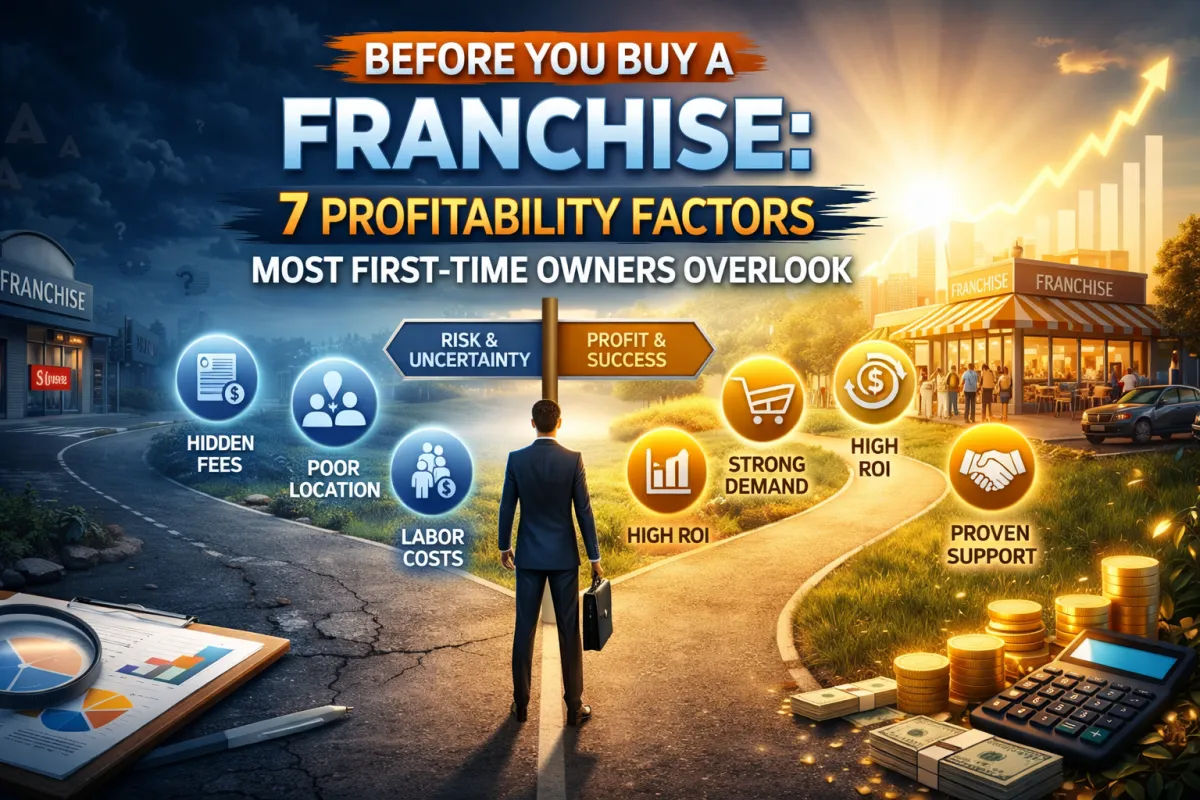
Before You Buy a Franchise: 7 Profitability Factors Most First-Time Owners Overlook
Most people who plan to buy a franchise usually start with the same thought: Will this business actually make money?
That question ultimately comes down to two important ideas: franchise profitability and franchise ROI.
Franchise profitability simply refers to how much money a franchise location earns after covering its operating costs, such as rent, labor, inventory, marketing fees, and royalties. It reflects the financial health of the business on a day-to-day basis.
On the other hand, franchise ROI (Return on Investment) measures how long it takes for a franchise owner to recover the initial investment and start generating real financial returns. It evaluates whether the capital you invested in the business is working efficiently over time.
Many first-time buyers focus only on brand popularity or the initial investment required to buy a franchise. But the real question is whether the business model can deliver strong franchise profitability and sustainable franchise ROI over the long run.
If you are evaluating opportunities today, understanding the deeper factors that influence franchise profitability can help you make a much more informed decision.
1. Unit Economics Matter More Than Brand Name
A strong brand may attract customers, but brand recognition alone does not guarantee franchise profitability. What truly determines performance is the unit economics of the business.
Unit economics includes factors like average ticket size, cost of goods, operating expenses, and profit margins at a single location. These numbers reveal whether the business model can produce consistent financial performance.
Before you buy a franchise, study how individual locations perform. When the unit economics are strong, the potential for higher franchise ROI becomes much clearer.
2. Location Still Shapes Revenue Potential
Even the best franchise model can struggle in the wrong location. Customer traffic, accessibility, neighborhood demographics, and nearby competition all influence franchise profitability.
Two franchise owners operating the same brand may see very different results simply because their locations attract different levels of demand.
When evaluating a brand before you buy a franchise, examine how similar locations perform in comparable markets. A strong location often accelerates franchise ROI.
3. Labor Structure Can Impact Margins
Labor is one of the largest recurring expenses in most franchise businesses. If the staffing requirements are too high or employee turnover is frequent, it can quickly affect franchise profitability.
Understanding the labor model is critical. Ask questions about the number of employees needed per shift, the level of training required, and how much supervision the operation demands.
A well-structured labor model can help maintain healthier margins and improve franchise ROI once you buy a franchise.
4. Royalty and Fee Structure
Franchises operate with ongoing fees that support the brand system. These typically include royalty payments, national marketing contributions, and technology or support fees.
While these fees provide value, they also directly influence franchise profitability.
Before deciding to buy a franchise, it is important to understand how these fees affect your bottom line. Even small differences in fee structures can impact long-term franchise ROI.
5. Local Market Demand
A franchise concept must align with local consumer behavior to achieve consistent franchise profitability.
Customer spending patterns, population density, and lifestyle trends all influence demand. A concept that performs exceptionally well in one region may struggle in another if the market dynamics are different.
Evaluating market demand before you buy a franchise helps you understand whether the concept has the potential to deliver reliable franchise ROI.
6. Operational Simplicity
Operational complexity is another factor that directly impacts franchise profitability. Businesses with complicated systems, large menus, or highly technical processes can become difficult to manage.
Simpler operational models are often easier to train, easier to scale, and easier to maintain.
When you buy a franchise, choosing a model with streamlined operations can help stabilize costs and improve long-term franchise ROI.
7. Strength of the Franchise Support System
Franchise systems vary widely in the level of support they provide. Training programs, operational guidance, marketing support, and technology platforms all contribute to franchise profitability.
A strong franchisor helps franchise owners navigate challenges and optimize their operations. This support can significantly improve the chances of achieving a healthy franchise ROI.
Before you buy a franchise, take time to understand the level of support the franchisor offers to new and existing owners.
Buying a franchise is not just about choosing a brand. It is about understanding what truly drives franchise profitability and long-term franchise ROI.
If you are planning to buy a franchise, having the right guidance can help you evaluate opportunities more clearly and avoid costly mistakes.
Rewired Franchise Advisors help aspiring owners identify franchise opportunities with strong franchise profitability potential and realistic franchise ROI expectations.
If you are ready to explore the right opportunity, book a FREE call with Rewired Franchise Advisors and take the first step toward informed franchise ownership.